(eng)
arquitectura plástica / golondrina dáurica (Cecropis daurica) and the use of clay
At the south-west edge of Joya a barranco runs down from the higher ground — a steep-sided ravine, usually dry, cut by the sudden passage of water after rain. Its sides and bed are largely marl, a soft sedimentary mixture of bright white clay and limestone that readily breaks down when wet.
In the 1950s, stone dykes were built across the barranco to slow the water and hold back erosion. The barranco lies within the watershed of the Río Segura and drains ultimately towards the Pantano de Valdeinfierno, a reservoir now heavily silted by material carried down through generations of seasonal and sometimes very energetic rainfall. The dykes at Joya still do their work. During these heavy rains they become large cascades. Milky water carries the loosened marl downstream, sifting clay and fine alluvium from the coarser material and depositing them in mud pools at the foot of the stones.
These pools persevere into the dry season as wallows for wild boar. The concentration of rainfall and runoff within the ravine, combined with the shade and shelter offered by its depth, holds moisture in the ground long after the surrounding land has desiccated.
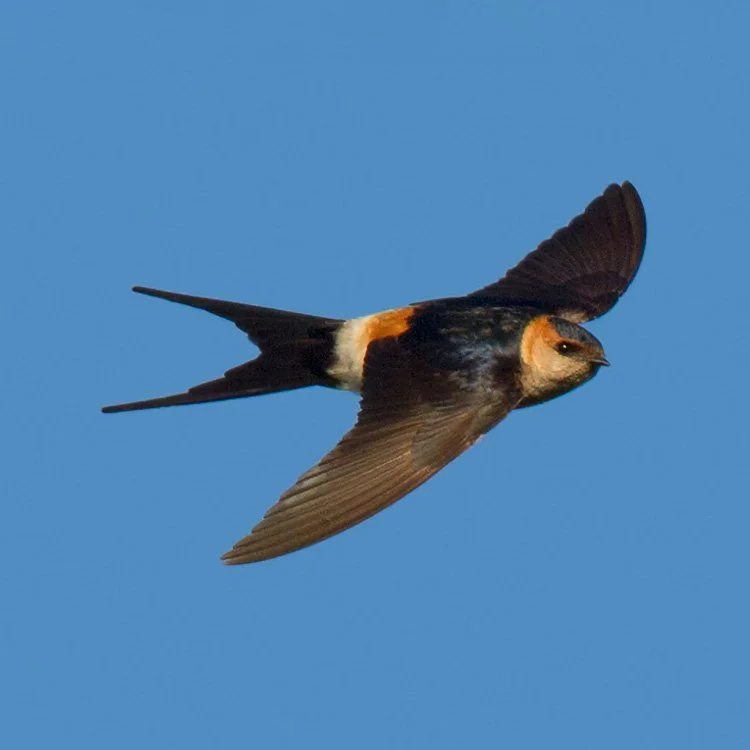
This is where the red-rumped swallows (Cecropis daurica) come for clay.
Each spring they return to Joya and to a nest built within a deep window opening in the cortijo. Quite unlike the open cup of the more familiar barn swallow, it is a closed mud chamber drawn out into a narrow tubular entrance, rather like the neck of a bottle. A mature nest is roughly 20–30 cm across, its entrance tunnel extending perhaps another 10–20 cm. The whole structure can approach 30–40 cm in length, while the opening itself is only a few centimetres across — sufficient for the swallow to pass through.
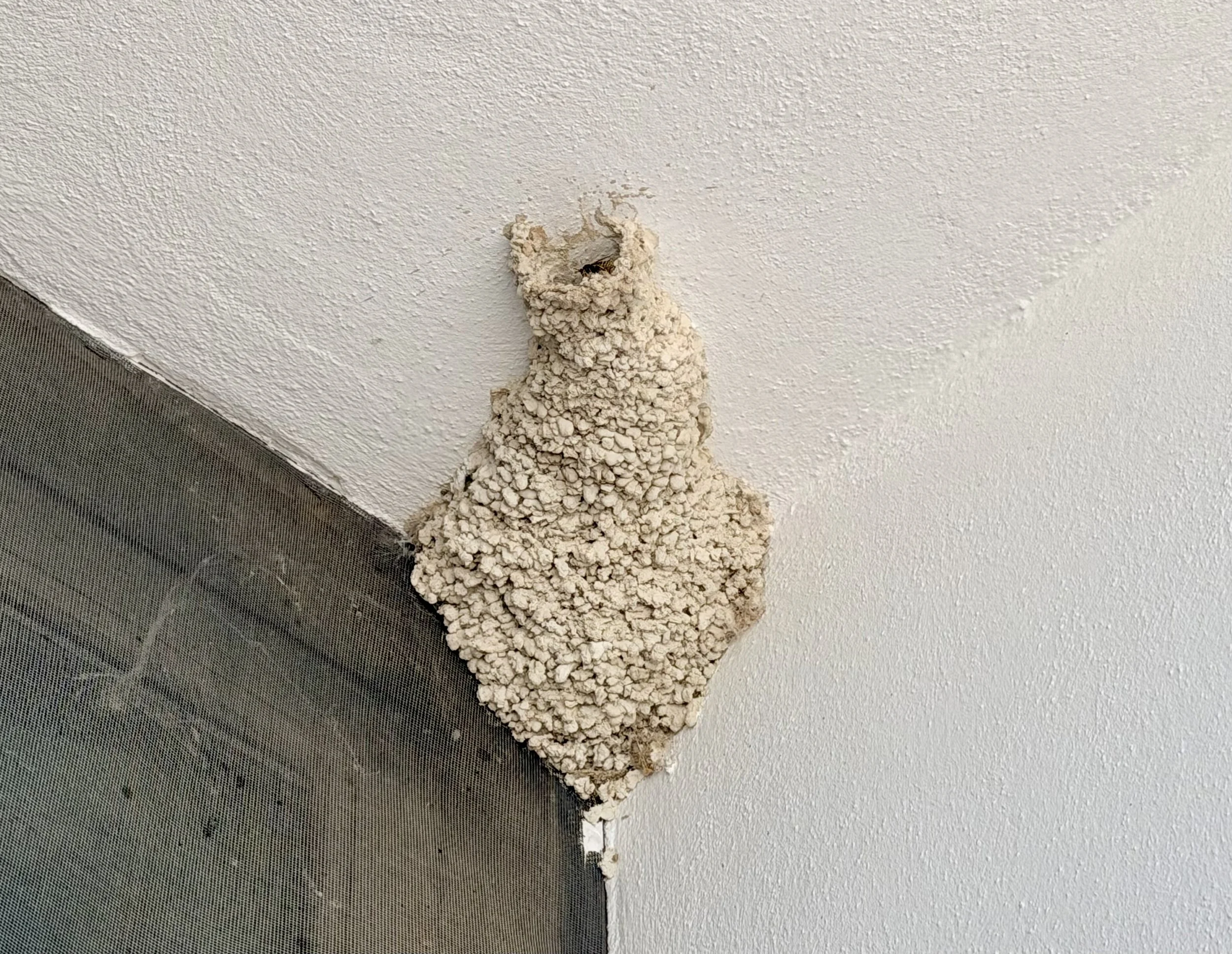
It isn't modelled from a single mass of clay. The birds carry the mud as small pellets, generally no more than a beakful at a time, building through repeated deposition. A finished nest can require many hundreds of individual loads, accumulated over days or weeks. The chamber is subsequently lined with dry grasses, fibres and feathers.
Architecturally, this gives us several quite precise characteristics:
cantilevered / accretive / thin-walled / enclosed / tubular / load-bearing / air-dried / composite
Accretive is important. The architecture grows through addition. There is no framework onto which the clay is applied; material is simultaneously structure and surface. Each wet pellet adheres to the preceding one and, as it dries, becomes part of the structure that supports the next.
The form is strikingly economical. The chamber expands sufficiently to contain the nest cup and young, while the narrow neck projects outwards to make a protected entrance. Ordinarily such a structure takes advantage of the junction between wall and soffit. Here it occupies the shelter of a deep-walled window opening in the cortijo: bird architecture accommodated within human architecture.
There is something wonderfully direct about the journey that builds this structure. Marl eroded from the barranco is carried by water and refined as it passes through stone dykes placed there by people seventy years ago. Water keeps the finer material workable. The swallow gathers it and carries it to the house. What was sediment becomes architecture.
Clay is particular in this way. It asks to be understood through touch, water and use. Too wet and it will not hold. Too dry and it cannot be worked. Its character depends upon the ground from which it comes and the minerals and particles within it. The swallow knows none of this as theory. It knows it by building.
There is a kind of medium specificity here. The nest could not be made in quite the same way from grass, twigs or stone. Its form belongs to the possibilities of wet earth: its plasticity, adhesion and its capacity to harden as it dries.
Nor is the clay entirely wild. Its availability is partly the consequence of an old human intervention in the barranco. The dyke slows the water. The water sorts the marl and holds the mud. The depth of the ravine protects its moisture. The mud allows the swallow to build. And the cortijo provides the architecture within which the nest survives.
A small chain of dependencies connects the bird on the building to rain, water, marl, stone and the history of people working this land. The swallow gathers a little of that landscape in its beak and brings it home.
Naturally, the most significant dependency lies inside the dark chamber of the clay structure. One summer a resident artist, whose room was adjacent to the nest, recorded the calls of the fledgling swallows within. When he played the recording back to me in the garden, the parent birds appeared immediately above our heads, attentive and bewildered by the sound of their young coming from somewhere they could not see.
We stopped the recording at once, for fear of disrupting them. But the encounter was a small reminder of what all this material ingenuity is for. The journeys to the barranco, the beakfuls of mud, the hundreds of small additions, the shelter of the window and the continual passage of the parents in and out of that narrow clay neck — all this energy and industry directed towards the persistence of life.
(esp)
arquitectura plástica / golondrina dáurica (Cecropis daurica) y el uso de la arcilla
En el extremo suroeste de Joya, un barranco desciende desde las tierras más altas: una hondonada de laderas escarpadas, normalmente seca, excavada por el paso repentino del agua después de la lluvia. Sus laderas y su lecho están formados en gran parte por margas, una mezcla sedimentaria blanda de arcilla de un blanco intenso y caliza que se deshace fácilmente al mojarse.
En la década de 1950 se construyeron diques de piedra a lo largo del barranco para frenar el agua y contener la erosión. El barranco forma parte de la cuenca hidrográfica del río Segura y sus aguas terminan llegando al Pantano de Valdeinfierno, un embalse hoy muy colmatado por los materiales arrastrados durante generaciones de lluvias estacionales y, en ocasiones, de gran intensidad. Los diques de Joya siguen cumpliendo su función. Durante estas lluvias fuertes se convierten en grandes cascadas. El agua lechosa arrastra las margas desprendidas barranco abajo, separando la arcilla y los aluviones finos de los materiales más gruesos y depositándolos en charcas de barro al pie de las piedras.
Estas charcas persisten hasta bien entrada la estación seca y sirven de revolcaderos para los jabalíes. La concentración de la lluvia y la escorrentía dentro del barranco, junto con la sombra y el abrigo que proporciona su profundidad, conserva la humedad del terreno mucho después de que las tierras circundantes se hayan desecado.
Es aquí donde las golondrinas dáuricas (Cecropis daurica) vienen a buscar arcilla.
Cada primavera regresan a Joya y a un nido construido en el interior del profundo hueco de una ventana del cortijo. Muy distinto del nido abierto en forma de copa de la más familiar golondrina común, este consiste en una cámara cerrada de barro que se prolonga en una estrecha entrada tubular, semejante al cuello de una botella. Un nido maduro mide aproximadamente entre 20 y 30 cm de ancho, y el túnel de entrada puede prolongarse otros 10–20 cm. La estructura completa puede alcanzar entre 30 y 40 cm de longitud, mientras que la abertura apenas tiene unos centímetros de diámetro: lo suficiente para permitir el paso de la golondrina.
No está modelado a partir de una única masa de arcilla. Las aves transportan el barro en pequeñas pellas, por lo general no más de lo que cabe en el pico cada vez, y construyen mediante una deposición repetida. Un nido terminado puede requerir muchos cientos de estos pequeños aportes, acumulados a lo largo de días o semanas. Posteriormente, la cámara se reviste con hierbas secas, fibras y plumas.
Desde el punto de vista arquitectónico, esto nos proporciona una serie de características bastante precisas:
en voladizo / acretiva / de paredes finas / cerrada / tubular / portante / secada al aire / compuesta
Acretiva es importante. La arquitectura crece por adición. No existe una armadura sobre la que se aplique la arcilla; el material es simultáneamente estructura y superficie. Cada pella húmeda se adhiere a la anterior y, al secarse, pasa a formar parte de la estructura que sostendrá la siguiente.
La forma resulta sorprendentemente económica. La cámara se ensancha lo suficiente para contener la concavidad del nido y a las crías, mientras que el cuello estrecho se proyecta hacia fuera formando una entrada protegida. Normalmente, una estructura de este tipo aprovecha el encuentro entre muro y sofito. Aquí ocupa el abrigo del profundo hueco de una ventana del cortijo: arquitectura de aves alojada dentro de arquitectura humana.
Hay algo maravillosamente directo en el recorrido que construye esta estructura. La marga erosionada del barranco es transportada por el agua y refinada a medida que atraviesa los diques de piedra colocados allí por manos humanas hace setenta años. El agua mantiene trabajable el material más fino. La golondrina lo recoge y lo lleva hasta la casa. Lo que era sedimento se convierte en arquitectura.
La arcilla es particular en este sentido. Exige ser comprendida mediante el tacto, el agua y el uso. Demasiado húmeda y no se sostiene. Demasiado seca y no puede trabajarse. Su carácter depende del terreno del que procede y de los minerales y partículas que contiene. La golondrina no sabe nada de esto como teoría. Lo sabe construyendo.
Hay aquí una forma de especificidad del medio. El nido no podría hacerse de la misma manera con hierba, ramitas o piedra. Su forma pertenece a las posibilidades de la tierra húmeda: su plasticidad, su adherencia y su capacidad para endurecerse a medida que se seca.
Tampoco la arcilla es del todo silvestre. Su disponibilidad es, en parte, consecuencia de una antigua intervención humana en el barranco. El dique frena el agua. El agua separa la marga y retiene el barro. La profundidad del barranco protege su humedad. El barro permite construir a la golondrina. Y el cortijo proporciona la arquitectura dentro de la cual sobrevive el nido.
Una pequeña cadena de dependencias conecta al ave en el edificio con la lluvia, el agua, la marga, la piedra y la historia de quienes han trabajado esta tierra. La golondrina recoge un poco de ese paisaje en el pico y lo lleva a casa.
Naturalmente, la dependencia más importante se encuentra dentro de la oscura cámara de la estructura de arcilla. Un verano, un artista residente cuya habitación estaba junto al nido grabó las llamadas de los polluelos de golondrina en su interior. Cuando reprodujo la grabación para mí en el jardín, los padres aparecieron inmediatamente sobre nuestras cabezas, atentos y desconcertados ante el sonido de sus crías procedente de un lugar que no podían ver.
Detuvimos la grabación de inmediato, por temor a molestarlos. Pero aquel encuentro fue un pequeño recordatorio de para qué sirve todo este ingenio material. Los viajes al barranco, los picos cargados de barro, los cientos de pequeñas adiciones, el abrigo de la ventana y el continuo ir y venir de los padres a través de aquel estrecho cuello de arcilla: toda esa energía y laboriosidad dirigidas hacia la persistencia de la vida.