Joya: atlas / project definition / marco del proyecto (eng/esp)
(eng)
Joya: atlas is the culmination of twenty-one years of living and working at Joya: arte + ecología / AiR. During that time we have inhabited, observed and restored a Mediterranean landscape. We have watched terraces fall out of cultivation, scrub return and trees establish themselves. We have learnt where water runs after heavy rain, where it cuts into the ground and where it leaves soil and stone behind. The atlas brings this experience together and asks how it might guide the landscape’s future.
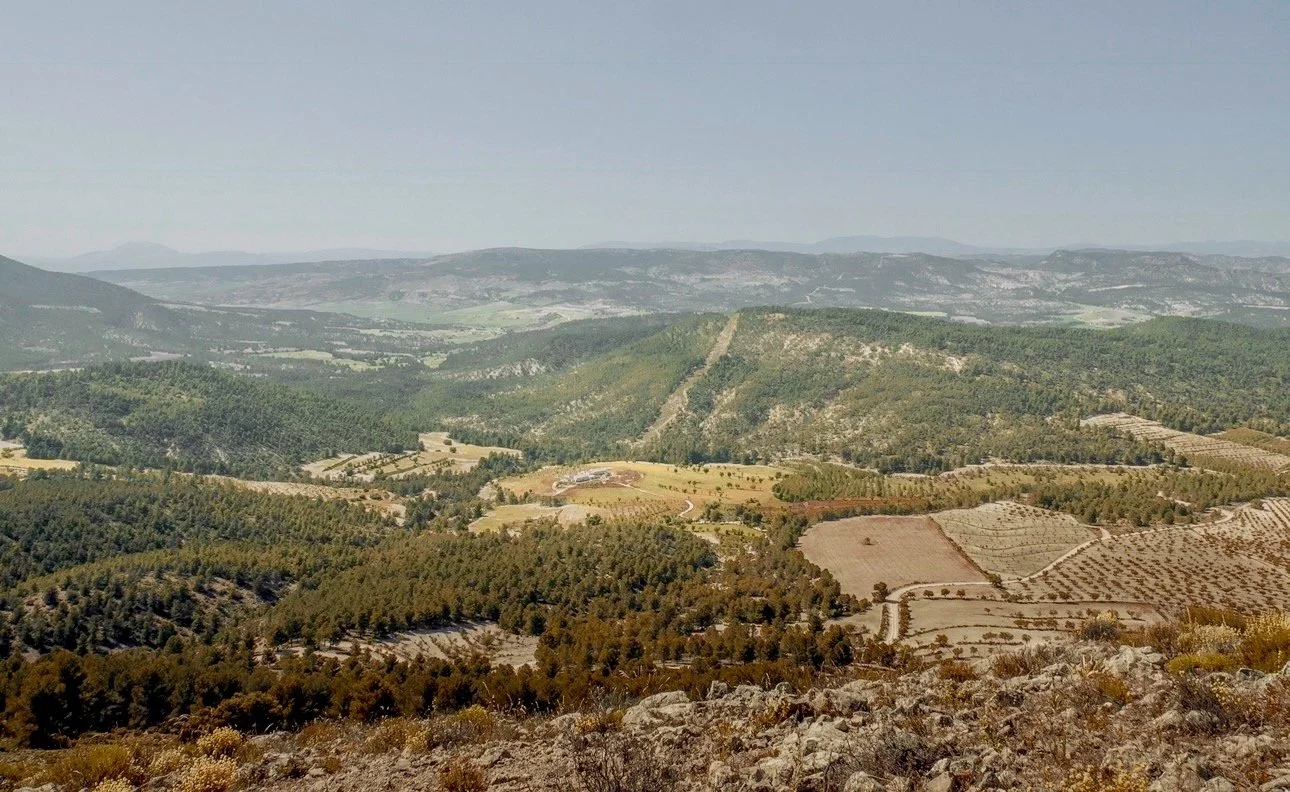
Joya covers twenty hectares in the Sierra María–Los Vélez. The atlas also reaches beyond its boundaries, since water, wildlife, fire and vegetation do not stop at cadastral lines. It brings together maps, field observation, research and cultural practice. It records topography, geology, parcels and histories of ownership. It follows water, cultivation, abandoned terraces, tracks and buildings. It attends to drought, erosion, wildfire, seasonal change and the movement of wildlife.
These things cannot be understood separately. Gravity carries water downhill, but the land alters its course. Old channels direct it. Collapsed terraces release soil. Vegetation slows its movement and holds the ground together. An abandoned field may become valuable habitat while also accumulating combustible scrub. Tracks and cultivated plots break the continuity of vegetation. Animals cross from one property to another. What happens outside Joya affects what happens within it.
The landscape extends through time as well as space. Earlier cultivation remains visible in terraces, boundaries, water systems and the altered shape of the ground. Some structures continue to work long after their original use has ended. Others are failing or have been taken over by plants and animals. History here is not background. It still directs water, movement and growth.
Joya: arte + ecología / AiR
Resilience, stewardship and coexistence
Joya: AiR cannot be held in a fixed state. Nor can it be isolated from climate change. Drought, wildfire, collapsing terraces, changing vegetation and the arrival or disappearance of species all shape its future. The question is how to work within that change.
Everything begins with close attention. One terrace may need clearing. Another may be developing valuable scrub habitat. A third might return to cultivation. Water may need holding in one place and allowing to pass through another. A nesting site may need protection from disturbance. Sometimes the appropriate response is to act. Sometimes it is to wait.
After twenty-one years at Joya, it is difficult to describe the landscape as either natural or human. Rain passes through terraces built by earlier generations. Scrub occupies fields that were once ploughed. Animals use tracks, walls, buildings and abandoned ground without regard for their original purpose.
These things cannot be understood separately. Gravity carries water downhill, but the land alters its course. Old channels direct it. Collapsed terraces release soil. Vegetation slows its movement and holds the ground together. An abandoned field may become valuable habitat while also accumulating combustible scrub. Tracks and cultivated plots break the continuity of vegetation. Animals cross from one property to another. What happens outside Joya affects what happens within it.
The landscape extends through time as well as space. Earlier cultivation remains visible in terraces, boundaries, water systems and the altered shape of the ground. Some structures continue to work long after their original use has ended. Others are failing or have been taken over by plants and animals. History here is not background. It still directs water, movement and growth.
Wendell Berry’s essay It All Turns on Affection offers a way of understanding the responsibility that grows from knowing a place. Affection, in his account, is a motive for the practical care of land and the life it supports. At Joya, this responsibility has developed through living and working within a landscape whose relationships we are still learning to understand. Water moves soil. Plants hold it in place. Animals carry seeds and occupy new habitats. Human activity enters these relationships, changing what can happen next.
For Joya: atlas, stewardship begins with attention to these relationships and to the consequences of our actions. Retaining water, restoring soil, cultivating selected terraces, managing vegetation, creating habitat and maintaining access are ways of putting care into practice. So are allowing natural regeneration, observing change and deciding to leave some ground alone. What matters is learning which response a particular place requires, and remaining willing to revise that judgement.
Across Joya, cultivated terraces sit beside abandoned ones. Woodland thickens in some places while other ground remains open. Tracks, buildings and clearings interrupt larger areas of vegetation. Water systems cross dry land. Human histories remain visible within habitats that are changing.
This variety matters. Different habitats and forms of land use respond differently to drought, fire and other pressures. If one part suffers, another may survive and recover. A landscape made uniform by total cultivation, total abandonment or a single model of rewilding would lose many of these differences. Joya: atlas instead works towards a mosaic: woodland, scrub, grassland, cultivated ground, abandoned terraces, water systems, paths, clearings, buildings and wildlife habitat.
The ecological term for such variety is heterogeneity. It can support more species and provide a greater range of shelter, food and nesting places. It can also retain the history of cultivation while making room for regeneration. Heterogeneity is one way of strengthening resilience: the capacity of the landscape to withstand disturbance, adapt and continue.
Resilience does not mean restoring an earlier, supposedly ideal condition. It means helping the land remain capable of supporting plants, animals, human life and culture as conditions change. This depends on interdependence. Water, soil, vegetation, wildlife, climate and human action continually affect one another.
The possibility towards which the project works is coexistence. People are neither removed from the landscape nor placed above it. Cultivation, culture, wildlife and regeneration may occupy the same territory, though their needs will not always agree. Coexistence is not a settled state. It has to be watched, tested and renewed.
At a time of climate change, biodiversity loss, land abandonment and the growing uniformity of landscapes, sustained attention to one place can itself be a form of resistance. Joya: atlas asks what might be achieved at an intimate scale by observing, mapping, cultivating, restoring, protecting, making and sometimes choosing not to intervene.
Stewardship is the practice through which this attention becomes care. Heterogeneity is the landscape strategy. Resilience is a capacity that may grow from this variety. Coexistence is the possibility towards which the project works.
attention → collaboration → interdependence → stewardship → heterogeneity → resilience → coexistence
The sequence is not a formula. Each part returns us to the others. Coexistence requires renewed attention. Resilience depends on relationships. Collaboration changes what is known. Every intervention alters the conditions that must next be observed.
Collaboration as a method
Joya: atlas grows out of twenty-one years at Joya: AiR. During that time artists, writers, researchers and other practitioners have lived and worked here. Each has brought a different way of seeing the landscape.
The atlas extends this exchange. Artistic practice will enter into conversation with ecology, botany, zoology, hydrology, geography, agriculture, forestry, archaeology and local knowledge. No single discipline can fully understand the land, and no one person can see all of its changes.
Collaboration may take the form of residencies, commissioned research, fieldwork, conversations, mapping, species identification, historical enquiry or practical work. Its effects may be visible in the wall chart or the book. They may also be found on the ground: in the route of a path, the position of a nesting bank, the retention of water, the clearing of vegetation or the decision not to disturb a particular place.
The land also gives information. Water shows where it wants to move. Plants reveal changes in soil, moisture and disturbance. Birds accept or reject a nesting site. The succession of an abandoned terrace may challenge an earlier plan for it. Collaboration includes responding to such evidence and recognising the limits of human intention.
Knowledge, like landscape, is produced through relationships. Joya: atlas is therefore a collective enquiry rather than a single vision imposed on the land. It brings together different people, disciplines and generations. It also makes room for the plants, animals and physical processes that will shape the outcome.
Histories embedded in the landscape
Older forms of knowledge remain built into Joya. The cañada y boquera is a dry watercourse and a traditional system for diverting episodic rainfall onto cultivated ground. It follows the slope and takes advantage of the brief arrival of water in an arid landscape. It does not control the rain completely. It works with its movement.
The system is both practical and historical. Its form records generations of watching water, soil and topography. Questions now described in terms of adaptation and resilience were already present in the daily work of Mediterranean agriculture.
These inherited structures continue to inform cultural practice at Joya. Simon Beckmann’s ongoing project Deposition is situated in relation to the cañada y boquera. It has developed through a long engagement with water, sediment, geology and infrastructure. The work attends to the ways the land is carried, deposited and formed again.
Within Joya: atlas, Deposition shows how artistic practice can emerge from the physical life of a place. Culture is not added to the landscape as a separate layer. Art, architecture, research, writing, walking and making can all become ways of reading it and taking part in its change.
Land stewardship is also a cultural practice. It carries memories, habits and values. Every restored wall, cultivated terrace, cleared track or area left to regenerate expresses a way of understanding the relationship between human intention and the life of the land.
Habitat, access and intervention
The protection, restoration and creation of habitat will form a significant part of Joya: atlas.
One developing project is a new nesting bank for Joya’s colony of European bee-eaters (Merops apiaster). Their present nesting site is vulnerable. Any alternative must be guided by the bank they already use: its material, orientation, height, exposure and relation to the surrounding ground. The birds will make the final judgement.
The new bank will be mapped and documented. Its construction, occupation or rejection will become part of the atlas. Failure would also be useful evidence. It might show that something important about the existing habitat had been missed.
A pathway will allow people to encounter the property’s different sites, ecologies and cultural works. It will be mapped, then selectively cut. Its route will follow the ground rather than forcing a line across it. Existing terraces and tracks, dense vegetation, steep slopes, wildlife habitat and sensitive areas will all affect its course.
Access changes a place. A path concentrates movement and makes some things visible while passing others by. Careful routing can help people understand the landscape without causing unnecessary disturbance.
Other work may include retaining and directing water, managing vegetation and fuel, restoring terraces, cultivating land, planting, building habitat and encouraging natural regeneration. Some places will require deliberate intervention. Elsewhere, the appropriate action may be to watch and allow existing processes to continue.
Each decision adds to the knowledge of the land. Its consequences must then be observed. In this way inherited practices, twenty-one years of stewardship, contemporary cultural work and future ecological adaptation become part of the same enquiry.
An evolving atlas
Joya: atlas will not have a single final form. It will develop through a large wall chart, an ongoing project of research and intervention, a book, and a changing presence on the website and social media. Each will work at a different pace.
The wall chart
At the physical centre of the project will be a large-scale wall chart of Joya and its immediate surroundings.
Its base will be built from cadastral information, aerial images, detailed contours and field observation. It will show parcels and boundaries, terraces, tracks, buildings, water infrastructure, vegetation, cultivated and abandoned land, wildlife habitats and neighbouring properties.
More information can be added, questioned and revised. Water movement may be traced after rainfall. Areas of fire risk or fuel management can be marked. Habitat, planting, land restoration, pathways and cultural interventions can appear on the same surface. The cañada y boquera and Deposition can be seen in relation to the wider topography and water system.
The wall chart will not be a finished map. It will be a working instrument. Information that is scattered across the ground can be brought together. Relationships that are hard to see while walking through the landscape may become clear. As knowledge grows and the land changes, the chart will change too.
The project
Beyond the wall chart, Joya: atlas will develop through field observation, ecological and historical research, photography, drawing, writing, mapping and work on the land.
A newly identified species can enter the atlas alongside an abandoned terrace or watercourse. So can a conversation with a specialist, an artwork, a habitat structure or the choice to leave an area untouched. The atlas allows these things to accumulate as connected knowledge rather than remain separate projects.
The landscape is its subject. It is also where the research happens.
The book
The book will be the most concentrated and enduring form of Joya: atlas. It will bring together maps, aerial images, photographs, drawings, archival and cadastral material, ecological observations, texts and records of cultural and ecological interventions.
It will use the form of an atlas rather than serve only as a catalogue. The reader will move between large and small scales, between present observations and historical evidence, and between different ways of seeing the same ground.
The cañada y boquera, Deposition, the bee-eater nesting bank and the pathway can become detailed studies within this larger view. Their histories, uncertainties and practical development will sit beside the spatial record of the whole property.
The book will look backwards through the physical and cultural history of Joya. It will record the landscape after twenty-one years of Joya: AiR and consider possible futures. It will be both a record of one place and a proposition about how cultural practice, ecological knowledge, collaboration and stewardship might contribute to resilience.
Website and social media
The landscape will continue to change, as will our understanding of it. The Joya website will provide a growing public archive of the atlas. It will contain maps, field notes, research, photographs, observations, texts, collaborations and records of interventions. The research will remain visible while it is happening, rather than appearing only when the book is complete.
Social media will work at a more immediate scale. It may follow water after rain, the mapping of a terrace, the return of a species, a change in vegetation or the construction and possible occupation of habitat. It can record cultivation, work on the pathway, fire management, archival discoveries, conversations with collaborators and the development of Depositionor other cultural works.
Over time, these fragments will form a chronology. Major interventions will appear beside slow and unexpected changes. The record will show that landscapes are made not only through large decisions but through seasons, small acts, accidents and the continued activity of other species.
An atlas without a final page
The wall chart is a working spatial instrument. The land is the field of observation and action. The website and social media form a changing public record. The book gathers these processes into a slower and more reflective form.
Together they allow Joya: atlas to move between mapping and making, historical evidence and present conditions, observation and intervention. They also allow it to remain unfinished.
Twenty-one years after the establishment of Joya: AiR, the atlas is both a culmination and a point of departure. It asks what prolonged attention to one place can reveal. It gathers what has been learnt through living and working here, while accepting how much remains unknown.
At its centre is a practical question. How can human activity work within natural processes to help this landscape withstand drought, wildfire, climate change and environmental degradation? How can it do so while sustaining biodiversity, cultural memory and possibilities for future life?
The scale is deliberately local: twenty hectares in the Sierra María–Los Vélez and the relationships that pass through them. Water arrives from elsewhere. Birds migrate across continents. Climate change and biodiversity loss are global forces. Yet they are encountered here in particular soils, terraces, plants, animals and decisions.
Within this small and specific territory lies a larger proposition. Close attention can lead to collaboration. Collaboration can reveal interdependence. From that understanding, people may learn to make with the landscape, preserve its heterogeneity and strengthen its resilience.
The possibility is coexistence: not a perfect balance, but a place where cultivation, culture, wildlife and natural regeneration can continue without any one of them claiming the whole ground. Against ecological degradation, biodiversity loss and homogenisation, Joya: atlas proposes that sustained work in one place can still matter beyond it.
attention → collaboration → interdependence → sympoiesis → heterogeneity → resilience → coexistence
This is an atlas of what the landscape has been, what it is now and what it may become. It is also an account of how we might take part in that becoming.
Simon Beckmann
(esp)
Joya: atlas
Joya: atlas es la culminación de veintiún años viviendo y trabajando en Joya: arte + ecología / AiR. Durante este tiempo hemos habitado, observado y restaurado un paisaje mediterráneo. Hemos visto cómo algunas terrazas dejaban de cultivarse, cómo volvía el monte bajo y cómo crecían los árboles. Hemos aprendido por dónde corre el agua después de una lluvia fuerte, dónde erosiona el terreno y dónde deposita tierra y piedras. El atlas reúne esta experiencia y se pregunta cómo puede orientar el futuro del paisaje.
Joya ocupa veinte hectáreas en la Sierra María–Los Vélez. El atlas también se extiende más allá de sus límites, porque el agua, la fauna, el fuego y la vegetación no se detienen ante las líneas catastrales. Reúne mapas, observaciones de campo, investigación y práctica cultural. Registra la topografía, la geología, las parcelas y las historias de propiedad. Sigue el agua, los cultivos, las terrazas abandonadas, los caminos y los edificios. Presta atención a la sequía, la erosión, los incendios, los cambios estacionales y el movimiento de la fauna.
Estas cosas no pueden entenderse por separado. La gravedad lleva el agua pendiente abajo, pero el terreno cambia su curso. Los antiguos cauces la dirigen. Las terrazas derrumbadas liberan tierra. La vegetación frena el agua y sujeta el suelo. Un campo abandonado puede convertirse en un hábitat valioso, pero también puede acumular vegetación combustible. Los caminos y las parcelas cultivadas interrumpen la continuidad de la vegetación. Los animales pasan de una propiedad a otra. Lo que sucede fuera de Joya afecta a lo que sucede dentro.
El paisaje se extiende en el tiempo, además de en el espacio. Los cultivos del pasado siguen siendo visibles en las terrazas, los límites, los sistemas de agua y la forma modificada del terreno. Algunas estructuras continúan funcionando mucho después de haber perdido su uso original. Otras se están deteriorando o han sido ocupadas por plantas y animales. Aquí la historia no es un simple fondo. Todavía dirige el agua, el movimiento y el crecimiento.
Joya: arte + ecologìa & AiR
Resiliencia, simpoiesis y coexistencia
Joya no puede conservarse en un estado fijo. Tampoco puede quedar aislada del cambio climático. Las sequías son cada vez más largas. El riesgo de incendio aumenta. Las terrazas se derrumban, la vegetación cambia y algunas especies llegan mientras otras desaparecen. La cuestión es cómo trabajar dentro de ese cambio.
Todo empieza por prestar mucha atención. Puede que una terraza necesite ser desbrozada. Otra puede estar recuperando un monte bajo valioso. Una tercera podría volver a cultivarse. En un lugar puede ser necesario retener el agua y en otro dejar que siga su curso. Un nido puede necesitar protección frente a las molestias. A veces la mejor decisión es actuar. Otras veces es esperar.
Después de veintiún años en Joya, resulta difícil describir el paisaje como natural o humano. La lluvia atraviesa terrazas construidas por generaciones anteriores. El monte bajo ocupa campos que antes se araban. Los animales utilizan caminos, muros, edificios y terrenos abandonados sin tener en cuenta para qué fueron construidos. El agua todavía sigue canales hechos por agricultores que ya no están aquí.
El término simpoiesis de Donna Haraway —hacer-con— da nombre a esta condición. Ningún paisaje se hace solo. El agua mueve la tierra. Las plantas la sujetan. Los animales transportan semillas y ocupan nuevos hábitats. Las personas cultivan, desbrozan, construyen, reparan y abandonan. Cada acción modifica lo que puede suceder después.
Para Joya: atlas, la simpoiesis es también una ética del cuidado de la tierra. La actividad humana forma parte del paisaje. La cuestión es qué tipo de actividad, dónde y con qué consecuencias. Retener agua, restaurar suelos, cultivar algunas terrazas, gestionar la vegetación, crear hábitats y mantener los accesos son formas de hacer-con. También lo son la regeneración natural, la observación y la decisión de dejar algunas zonas tranquilas.
En Joya, las terrazas cultivadas conviven con otras abandonadas. En algunos lugares el bosque se hace más denso, mientras que otros permanecen abiertos. Los caminos, los edificios y los claros interrumpen extensiones mayores de vegetación. Los sistemas de agua atraviesan terrenos secos. Las huellas de la historia humana siguen visibles dentro de hábitats que están cambiando.
Esta variedad importa. Los diferentes hábitats y usos del suelo responden de distinta manera a la sequía, el fuego y otras presiones. Si una parte sufre, otra puede sobrevivir y recuperarse. Un paisaje uniformado por el cultivo total, el abandono completo o un único modelo de renaturalización perdería muchas de estas diferencias. Joya: atlas trabaja, en cambio, hacia un mosaico: bosque, monte bajo, pastizal, terrenos cultivados, terrazas abandonadas, sistemas de agua, senderos, claros, edificios y hábitats para la fauna.
El término ecológico para esta variedad es heterogeneidad. Puede mantener más especies y ofrecer una mayor diversidad de refugios, alimentos y lugares de nidificación. También puede conservar la historia de los cultivos y, al mismo tiempo, dejar espacio para la regeneración. La heterogeneidad es una forma de fortalecer la resiliencia: la capacidad del paisaje para resistir las alteraciones, adaptarse y continuar.
La resiliencia no significa recuperar un estado anterior que se supone ideal. Significa ayudar a que la tierra siga siendo capaz de sostener plantas, animales, vida humana y cultura mientras cambian las condiciones. Esto depende de la interdependencia. El agua, el suelo, la vegetación, la fauna, el clima y la actividad humana se afectan continuamente unos a otros.
La posibilidad hacia la que avanza el proyecto es la coexistencia. Las personas no quedan fuera del paisaje ni se sitúan por encima de él. Los cultivos, la cultura, la fauna y la regeneración pueden ocupar el mismo territorio, aunque sus necesidades no siempre coincidan. La coexistencia no es un estado estable. Hay que observarla, ponerla a prueba y renovarla.
En una época de cambio climático, pérdida de biodiversidad, abandono rural y creciente uniformidad de los paisajes, prestar una atención constante a un lugar puede ser en sí mismo una forma de resistencia. Joya: atlas se pregunta qué puede lograrse a una escala íntima mediante la observación, la cartografía, el cultivo, la restauración, la protección, la creación y, a veces, la decisión de no intervenir.
Un marco conceptual
El proyecto puede describirse mediante una secuencia:
atención → colaboración → interdependencia → simpoiesis → heterogeneidad → resiliencia → coexistencia
La atención es lo primero. Significa observar un lugar concreto a lo largo del tiempo. Incluye a sus habitantes, sus historias y sus condiciones cambiantes.
La atención también revela los límites de cualquier punto de vista individual. Esto conduce a la colaboración. Artistas, ecólogos, agricultores, investigadores y personas con conocimientos locales se fijan en cosas distintas. Su trabajo permite ver las relaciones. El agua afecta al suelo; el suelo y la orientación afectan a la vegetación; la vegetación influye en el fuego, la fauna y el movimiento del agua. Las decisiones humanas entran en todas las partes de este patrón.
Estas relaciones hacen visible la interdependencia. La simpoiesis describe la condición y la ética que se desprenden de ella: hacer-con. La colaboración es la manera de trabajar del proyecto. La heterogeneidad es su estrategia para el paisaje. La resiliencia es una capacidad que puede crecer a partir de esta variedad. La coexistencia es la posibilidad hacia la que avanza.
La secuencia no es una fórmula. Cada elemento nos devuelve a los demás. La coexistencia exige una atención renovada. La resiliencia depende de las relaciones. La colaboración cambia lo que sabemos. Cada intervención modifica las condiciones que después habrá que observar.
La colaboración como método
Joya: atlas nace de veintiún años de trabajo en Joya: AiR. Durante este tiempo, artistas, escritores, investigadores y otros profesionales han vivido y trabajado aquí. Cada uno ha aportado una forma diferente de mirar el paisaje.
El atlas amplía este intercambio. La práctica artística dialogará con la ecología, la botánica, la zoología, la hidrología, la geografía, la agricultura, la silvicultura, la arqueología y los conocimientos locales. Ninguna disciplina puede comprender por completo la tierra. Ninguna persona puede ver todos sus cambios.
La colaboración puede tomar la forma de residencias, investigaciones por encargo, trabajo de campo, conversaciones, cartografía, identificación de especies, investigación histórica o trabajo práctico sobre el terreno. Sus efectos pueden ser visibles en el mural o en el libro. También pueden encontrarse sobre la tierra: en el recorrido de un sendero, la posición de un talud de nidificación, la retención del agua, el desbroce de la vegetación o la decisión de no alterar un lugar concreto.
La propia tierra también aporta información. El agua muestra por dónde quiere avanzar. Las plantas revelan cambios en el suelo, la humedad y las alteraciones del terreno. Las aves aceptan o rechazan un lugar de nidificación. La sucesión vegetal en una terraza abandonada puede cuestionar un plan anterior. Colaborar también significa responder a estas señales y reconocer los límites de la intención humana.
El conocimiento, como el paisaje, se produce mediante relaciones. Por eso, Joya: atlas es una investigación colectiva y no una visión única impuesta sobre la tierra. Reúne a distintas personas, disciplinas y generaciones. También deja espacio para las plantas, los animales y los procesos físicos que darán forma al resultado.
Historias presentes en el paisaje
En Joya siguen construidas formas antiguas de conocimiento. La cañada y boquera es un cauce seco y un sistema tradicional que desvía la lluvia ocasional hacia los terrenos de cultivo. Sigue la pendiente y aprovecha la breve llegada del agua a un paisaje árido. No controla la lluvia por completo. Trabaja con su movimiento.
El sistema es a la vez práctico e histórico. Su forma guarda la experiencia de generaciones observando el agua, el suelo y la topografía. Las cuestiones que ahora describimos como adaptación y resiliencia ya estaban presentes en el trabajo cotidiano de la agricultura mediterránea.
Estas estructuras heredadas siguen influyendo en la práctica cultural de Joya. El proyecto en curso de Simon Beckmann, Deposition, está situado en relación con la cañada y boquera. Se ha desarrollado a partir de un largo trabajo con el agua, los sedimentos, la geología y las infraestructuras. La obra presta atención a las formas en que la tierra es transportada, depositada y formada de nuevo.
Dentro de Joya: atlas, Deposition muestra cómo la práctica artística puede surgir de la vida física de un lugar. La cultura no se añade al paisaje como una capa separada. El arte, la arquitectura, la investigación, la escritura, el caminar y el hacer pueden convertirse en formas de leerlo y participar en su cambio.
El cuidado de la tierra también es una práctica cultural. Lleva consigo recuerdos, costumbres y valores. Cada muro restaurado, cada terraza cultivada, cada camino desbrozado y cada zona que se deja regenerar expresa una manera de entender la relación entre la intención humana y la vida de la tierra.
Hábitat, acceso e intervención
La protección, restauración y creación de hábitats serán una parte importante de Joya: atlas.
Uno de los proyectos en desarrollo es un nuevo talud de nidificación para la colonia de abejarucos europeos (Merops apiaster) de Joya. Su lugar de nidificación actual es vulnerable. Cualquier alternativa debe basarse en el talud que ya utilizan: su material, orientación, altura, exposición y relación con el terreno que lo rodea. Las aves tomarán la decisión final.
El nuevo talud será cartografiado y documentado. Su construcción, ocupación o rechazo pasarán a formar parte del atlas. El fracaso también aportaría información útil. Podría mostrar que no habíamos entendido algún aspecto importante del hábitat actual.
Un sendero permitirá que las personas conozcan los diferentes lugares, ecologías y obras culturales de la propiedad. Primero se cartografiará y después se abrirá de forma selectiva. Su recorrido seguirá el terreno en lugar de imponer una línea sobre él. Las terrazas y caminos existentes, la vegetación densa, las pendientes pronunciadas, los hábitats de la fauna y las zonas sensibles influirán en su trazado.
El acceso cambia un lugar. Un sendero concentra el movimiento y hace visibles algunas cosas mientras deja otras fuera de la vista. Un recorrido cuidadoso puede ayudar a las personas a comprender el paisaje sin causar molestias innecesarias.
Otros trabajos pueden incluir la retención y conducción del agua, la gestión de la vegetación y el combustible, la restauración de terrazas, el cultivo, la plantación, la construcción de hábitats y el fomento de la regeneración natural. Algunos lugares necesitarán una intervención deliberada. En otros, la acción adecuada puede ser observar y permitir que los procesos existentes continúen.
Cada decisión amplía el conocimiento de la tierra. Después habrá que observar sus consecuencias. De esta manera, las prácticas heredadas, veintiún años de cuidado, el trabajo cultural contemporáneo y la futura adaptación ecológica pasan a formar parte de una misma investigación.
Un atlas en evolución
Joya: atlas no tendrá una única forma definitiva. Se desarrollará mediante un gran mural, un proyecto continuo de investigación e intervención, un libro y una presencia cambiante en el sitio web y las redes sociales. Cada elemento funcionará a un ritmo diferente.
El mural
En el centro físico del proyecto habrá un mural a gran escala de Joya y su entorno inmediato.
Su base se construirá a partir de información catastral, imágenes aéreas, curvas de nivel detalladas y observaciones de campo. Mostrará las parcelas y sus límites, las terrazas, los caminos, los edificios, las infraestructuras de agua, la vegetación, los terrenos cultivados y abandonados, los hábitats de la fauna y las propiedades vecinas.
Se podrá añadir, cuestionar y revisar más información. El movimiento del agua podrá trazarse después de la lluvia. Se podrán marcar las zonas de riesgo de incendio o de gestión del combustible. Los hábitats, las plantaciones, la restauración del terreno, los senderos y las intervenciones culturales podrán aparecer sobre la misma superficie. La cañada y boquera y Deposition podrán verse en relación con la topografía y el sistema de agua más amplios.
El mural no será un mapa terminado. Será un instrumento de trabajo. La información dispersa por el terreno podrá reunirse en él. Algunas relaciones difíciles de ver mientras se recorre el paisaje podrán hacerse más claras. A medida que crezca el conocimiento y cambie la tierra, el mural también cambiará.
El proyecto
Más allá del mural, Joya: atlas se desarrollará mediante la observación de campo, la investigación ecológica e histórica, la fotografía, el dibujo, la escritura, la cartografía y el trabajo sobre la tierra.
Una especie recién identificada podrá entrar en el atlas junto a una terraza abandonada o un cauce de agua. También una conversación con un especialista, una obra artística, una estructura para la fauna o la decisión de dejar una zona sin tocar. El atlas permite que estas cosas se acumulen como conocimientos relacionados, en lugar de permanecer como proyectos separados.
El paisaje es su tema. También es el lugar donde se realiza la investigación.
El libro
El libro será la forma más concentrada y duradera de Joya: atlas. Reunirá mapas, imágenes aéreas, fotografías, dibujos, materiales históricos y catastrales, observaciones ecológicas, textos y registros de intervenciones culturales y ecológicas.
Utilizará la forma de un atlas, en lugar de limitarse a ser un catálogo. El lector pasará de las escalas grandes a las pequeñas, de las observaciones actuales a las pruebas históricas y entre distintas formas de mirar el mismo terreno.
La cañada y boquera, Deposition, el talud de nidificación de los abejarucos y el sendero podrán convertirse en estudios detallados dentro de esta visión más amplia. Sus historias, incertidumbres y desarrollo práctico aparecerán junto al registro espacial de toda la propiedad.
El libro mirará hacia atrás, hacia la historia física y cultural de Joya. Registrará el paisaje después de veintiún años de Joya: AiR y considerará posibles futuros. Será un documento sobre un lugar concreto y, a la vez, una propuesta sobre cómo la práctica cultural, el conocimiento ecológico, la colaboración y el cuidado de la tierra pueden contribuir a la resiliencia.
Sitio web y redes sociales
El paisaje seguirá cambiando, al igual que nuestra forma de entenderlo. El sitio web de Joya ofrecerá un archivo público y creciente del atlas. Contendrá mapas, notas de campo, investigaciones, fotografías, observaciones, textos, colaboraciones y registros de las intervenciones. La investigación permanecerá visible mientras se desarrolla, en lugar de aparecer solo cuando el libro esté terminado.
Las redes sociales funcionarán a una escala más inmediata. Podrán seguir el agua después de la lluvia, la cartografía de una terraza, el regreso de una especie, un cambio en la vegetación o la construcción y posible ocupación de un hábitat. También podrán registrar los cultivos, el trabajo en el sendero, la gestión de incendios, los descubrimientos de archivo, las conversaciones con colaboradores y el desarrollo de Deposition o de otras obras culturales.
Con el tiempo, estos fragmentos formarán una cronología. Las grandes intervenciones aparecerán junto a los cambios lentos e inesperados. El registro mostrará que los paisajes no se forman solo mediante grandes decisiones, sino también a través de las estaciones, los pequeños actos, los accidentes y la actividad continua de otras especies.
Un atlas sin última página
El mural es un instrumento espacial de trabajo. La tierra es el campo de observación y acción. El sitio web y las redes sociales forman un registro público en constante cambio. El libro reúne estos procesos en una forma más lenta y reflexiva.
Juntos permiten que Joya: atlas se mueva entre la cartografía y el hacer, las pruebas históricas y las condiciones actuales, la observación y la intervención. También permiten que permanezca abierto.
Veintiún años después de la creación de Joya: AiR, el atlas es una culminación y un punto de partida. Se pregunta qué puede revelar la atención prolongada a un lugar. Reúne lo aprendido al vivir y trabajar aquí, pero reconoce todo lo que todavía desconocemos.
En su centro hay una cuestión práctica. ¿Cómo puede la actividad humana trabajar dentro de los procesos naturales para ayudar a este paisaje a resistir la sequía, los incendios, el cambio climático y el deterioro medioambiental? ¿Cómo puede hacerlo mientras sostiene la biodiversidad, la memoria cultural y las posibilidades de vida futura?
La escala es deliberadamente local: veinte hectáreas en la Sierra María–Los Vélez y las relaciones que las atraviesan. El agua llega de otros lugares. Las aves migran entre continentes. El cambio climático y la pérdida de biodiversidad son fuerzas globales. Sin embargo, aquí se experimentan en suelos, terrazas, plantas, animales y decisiones concretas.
Dentro de este territorio pequeño y específico existe una propuesta más amplia. La atención cercana puede llevar a la colaboración. La colaboración puede revelar la interdependencia. A partir de esa comprensión, las personas pueden aprender a hacer-con el paisaje, conservar su heterogeneidad y fortalecer su resiliencia.
La posibilidad es la coexistencia: no un equilibrio perfecto, sino un lugar donde el cultivo, la cultura, la fauna y la regeneración natural puedan continuar sin que ninguno ocupe todo el terreno. Frente al deterioro ecológico, la pérdida de biodiversidad y la homogeneización, Joya: atlas propone que el trabajo continuado en un lugar todavía puede tener importancia más allá de él.
atención → colaboración → interdependencia → simpoiesis → heterogeneidad → resiliencia → coexistencia
Este es un atlas de lo que el paisaje ha sido, de lo que es ahora y de lo que puede llegar a ser. También es un relato de cómo podemos participar en ese proceso.
Simon Beckmann